History of Jersey 83-93 Banner sm photo History of Jersey 83-93 Banner sm.jpg

Thursday, June 24, 2010

1973-74 Minnesota North Stars Tom Reid Jersey

Born on this date in 1946, Tom Reid had a 12 year NHL career that started with the Chicago Black Hawks.

Tom Reid Black Hawks
Tom Reid with the Black Hawks

Reid, a defenseman played for the St. Catharines Black Hawks of the Ontario Hockey Association from 1964-65 to 1966-67. A defensive defenseman, Reid is described in his biography on the Hockey Hall of Fame's Legends of Hockey website as "a stay-at-home defender who viewed the offensive zone as a distant moon"!

He graduated from junior hockey just as the NHL expanded from six teams to 12 and landed a spot on the Chicago blueline with 56 games in his rookie season of 1967-68 as well as seeing his first taste of playoff action with nine postseason games. After 30 games with Chicago in 1968-69, he was traded to the Minnesota North Stars on Valentine's Day in 1968. In all, he played 86 games for the Black Hawks, totaling seven assists.

Reid competed in the final 18 games of the North Stars schedule and established himself as a regular the following season with 66 games played, which included his first NHL goal.

The 1970-71 season saw his offensive output leap up to 17 points, more than double his previous high of eight. Additionally, the North Stars would make a push in the playoffs, first defeating the St. Louis Blues in six games before stretching out the eventual champion Montreal Canadiens to six games for the right to play in the finals. The North Stars 6-3 Game 2 win in Montreal on April, 22 was the first time a 1967 expansion team had ever defeated an Original 6 club in the playoffs.

70-71 Tom Reid rookie card
Tom Reid's 1970-71 rookie card

The 1971-72 season was the most remarkable of Reid's career. It saw the player once described as "a sort of third goal post, firmly anchored to his own zone" go on a goal scoring binge, as he netted six for a career high, including by far the most memorable goal of his career.

Tom Reid
Reid doing his best imitation of a third goal post

On October 14, 1971 Tom Reid scored on a penalty shot against Hall of Famer Ken Dryden of the Canadiens. It was scored by the most unlikely of sources, a man who only scored 17 goals in his entire career and the only penalty shot ever scored against Dryden!

As told by long time North Stars announcer Al Shaver in "Minnesota North Stars: History and Memories with Lou Nanne"
Let's not forget the shot that was heard around the world. Well, maybe just the hockey world. Allan Thomas Reid was not a prolific scorer among NHL defensemen. In a span of 10 shin-bruising seasons with the North Stars, Tall Tommy scored only 17 goals, but on the night of October 14, 1971, he performed a feat that put him in a class by himself and earned him a place in the team history book. On one of his rare good scoring opportunities, Reid was fouled by a Montreal player and the referee awarded him a penalty shot.

Coach Jack Gordon, showing supreme confidence in Reid's scoring prowess, asked the ref, "Does Reid have to take the shot?" To young Thomas that was the ultimate insult, but take the shot he did. Unleashing all of his anger over the coach's lack of confidence, Reid launched a blistering rocket that left Ken Dryden trembling in his skates. The twine behind Dryden bulged, the red light flashed, bells chimed, fireworks filled the air, brass bands started playing, an thousands of fans began chanting, "Tommy! Tommy! Tommy!" And so, a hero was born on that autumn evening, many years ago.
Reid's own version of the event naturally differs slightly from Shavers.
I came out of the penalty box and was heading toward the bench when a clearing pass hit my skate and careened toward the Montreal zone. Instead of going to the bench I went after the puck and had a clear breakaway. Guy Lapointe tripped me from behind and I slid hard into the boards.

Referee Bruce Hood skated over and asked if I was okay. I said "Yes," and then, "You're giving him a penalty, right?" He said, "You're getting a penalty shot." I said: "Bruce, go to hell. I don't want a penalty shot." "You got one," he replied.

When I got to the bench, coach Jack Gordon asked what was going on. Hood skated over and said, "Let's go." Jack said, "What do you mean?" and was then informed of the penalty shot. Jack said, "Does he have to take the shot?" and I informed Hood that I thought my leg was broken. Hood said, "Let's go or you'll get a delay of game."

Everyone on the bench was giving me advice about what to do with the shot, but J. P. Parise simply said, "Put the damn thing behind him."

I was so focused as I got ready to take the puck that I couldn't hear a thing. There were 15,000 people in the building, but I heard nothing. It was a warm October night so the ice was a bit wet, and I was worried about carrying the puck across the blue line. My main concern was just getting off a shot.

I skated in, got to the high slot, and shot the puck. Ken Dryden wasn't expecting a shot that quickly and he overreacted. I was aiming for the corner, but the puck went between his legs and into the net, my big claim to fame.

When I got back to the bench, I said to Jack, "Was there ever any doubt?"
Tom Reid penalty shot
Tom Reid's famous penalty shot goal against Ken Dryden

Reid's 21 points for the season also raised his career best in that category as well. Additionally, his 107 penalty minutes established a career high. In the postseason, Reid scored the only playoff goal of his career against the Blues to cap off a most memorable season.

Two seasons later, Reid set a career hight with 23 points from four goals and a career best 19 assists in 76 games. He stayed true to his defensive roots the following season, again topping 70 games for the fourth time in five seasons with 74 games played, but managed just six points while leaving the point gathering to teammates Dennis Hextall (74 points) and Bill Goldsworthy (72). He did top 100 penalty minutes for only the second and final time in his career with 103.

Reid competed in 69 games in 1975-76, contributing 15 assists and 54 games in 1976-77, adding another eight assists to his career total.

Tom Reid

It was around this time that Reid developed a small red rash on his arm, which itched terribly as his skin began to deteriorate. Eventually the condition was given the name "gunk". Eventually league doctors, trainers and equipment manufacturers began to investigate and discovered that about 100 players across the NHL were suffering from various degrees of the same condition, but none as severe as Reid's, whose skin eventually got so bad that he could only sleep sitting upright in a wooden chair.

The condition was so severe, Reid was forced to retire after managing to play only 36 games of the 1977-78 season, in which he scored his final NHL goal and added six assists to push his career totals to 690 games played, 17 goals and 113 assists for 130 points as well as 42 playoff games with one goal and 13 assists. Doctors finally concluded that Reid's rash was caused by allergies to his hockey equipment and the dye in his jersey.

Former teammate Lou Nanne relates a story about Reid and his noted sense of humor:
Tom Reid was a terrific defensive defenseman. He was very consisent - game in and game out you knew you going to get strong defense from Tommy. His play never varied.

I had three concussions in my career. The third one was the result of a real good check by Dennis Owchar one night in Pittsburgh. At the doctor's suggestion, I had started wearing a helmet after my second concussion to help prevent further ones.

But this night in Pittsburgh I was playing defense with Tom Reid, and I was carrying the puck up the ice. I thought I had made a real good move to get by Owchar, but as I slipped the puck though his legs to try to go around him, he hit me with a shoulder right between my shoulder blades and I went down very hard. I hit my head on the ice so hard I eventually had seven stitches, even with the helmet.

I tired to get up, was real dizzy and started going back down again. The next thing I know, the trainer, Doc Rose, is on the ice telling me to lie down, that they're going to carry me off.

I said, "There's no way. I've never been carried off the ice, and I'm not going to let anybody carry me off now."

I tried to get up again, and I went right back down. And as I'm going down this time, Tom Reid leans over and says. "Louie, Louie, before you go, can I have your condominium in Florida?"
Since his retirement from hockey, armed with that same sense of humor, he has worked as a color analyst for the North Stars, Minnesota Gophers and now the Minnesota Wild. He is also the president of the North Stars Almuni Chapter and owner of Tom Reid's Hockey City Pub, the place to meet before and after Wild home games down the street at the Xcel Energy Center and site of the annual Hockey Collectors Expo, next scheduled for Sunday October 3rd from 11 AM to 6 PM, where local collectors share their game worn jersey collections.

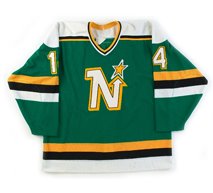
Today's featured jersey is a 1973-74 Minnesota North Stars Tom Reid jersey. This was the third style of green jersey worn by the North Stars, with the original having a lace up collar, which was dropped during their first season for a v-neck collar. Starting in season two in 1968-69, a white shoulder yoke was added to the jerseys. This third style remained in use through the 1974-75 season.

1973-74 Minnesota North Stars jersey

Our video section today begins with a look at the 1975-76 Minnesota North Stars, some of the crappiest, most annoying filmmaking in the history of sports. If you choose to suffer though Part 1, I recommend skipping ahead to the 3:58 mark. Perhaps Parts 2 through 5 improve after getting past the first half of Part 1. You click the link, you take your chances...


Wednesday, June 23, 2010

1905-06 Portage Lake Hockey Club Cyclone Taylor Jersey

Born on this date in 1884, Fred "Cyclone" Taylor was one of the first stars of the fledgling sport of hockey and one of the leading scorers of his day.

As was common in the early days of organized hockey, Taylor played for several teams in several leagues - depending on where the money was. He joined his is first professional club, thanks to a $3,000 salary offer, the Portage Lakes Hockey Club in Houghton, Michigan in the International Professional Hockey League. Taylor arrived in the latter part of the 1905-06 season in time to score 11 goals in 6 games and help the club win the league championship with a 19-5 record.

He returned for the 1906-07 season and scored 14 times in 23 games as Portage Lakes again won the championship, this time with a record of 16-8. With professional teams now starting up in Canada, many of the players preferred to play closer to home and the IPHL disbanded after before the start of the next season.

Taylor moved back east, joining the Ottawa Senators of the Eastern Canada Amateur Hockey Association for the 1907-08 season. In 1908, Taylor played the start of the season with Pittsburgh of the Western Pennsylvania Hockey League but returned to Ottawa in time for the start of the Senators next season. Once back, he scored 9 goals in 11 games as Ottawa won the league title with a 10-2 record. As champions of the league, Ottawa became the holders of the Stanley Cup, previously held by league members the Montreal Wanderers.

Taylor Ottawa 1909
Taylor of the Ottawa Senators

It was during this period that Canada's Governor General was so impressed with his incredible speed that he gave Taylor the nickname "Cyclone".

Fred Cyclone Taylor signature

After a falling out with management of Ottawa, Taylor accepted an offer to join the Renfrew Creamery Kings for the inaugural season of the National Hockey Association.

1911 C55 Taylor

There he was joined by future hall of famers Lester Patrick, his brother Frank Patrick as well as mid-season addition Newsy Lalonde. The paychecks handed out to the Renfew players earned the club the unofficial nickname of the Renfrew "Millionaires". Taylor's salary in particular was the highest ever for a Canadian athlete up to that time and remained so for many years.

Lalonde,F Patrick & Taylor 1912
Newsy Lalonde, Frank Patrick and Cyclone Taylor of Renfrew

Despite their high priced talent, Renfrew finished third in the league and reportedly lost $17,000 that season. Taylor returned for the 1910-11 season, only without the Patricks or Lalonde.

The club once again finished third in the standings and disbanded following the season, putting Taylor back on the open market. Sort of.

His rights were transferred to the Montreal Wanderers, but Taylor was quoted as saying he'd rather retire than join the Wanderers and ended up playing in a game for the Ottawa Senators. The Wanderers protested Taylor's appearance for Ottawa and won. The game was ordered replayed, Taylor and Ottawa were fined $100 each and Taylor was given an indefinite suspension, ending his 1911-12 season at one game.

In November of 1912, Taylor was lured to the Vancouver Millionaires by his former teammates the Patrick brothers, who had formed the Pacific Coast Hockey League.

Taylor Vancouver 1912-13
Taylor with the Vancouver Millionaires in 1912-13

There, he would find a permanent home, playing the next nine seasons of his career, which included five scoring titles, thanks in part to moving up to forward from defense, a career high of 32 goals in 18 games in 1917-18 and a Stanley Cup championship in 1915 thanks to a 3 games to none win over Taylor's former club, the Ottawa Senators which included Taylor scoring six times in the three games including twice in the cup clinching Game 3. The victory by the Millionaires remains the only Stanley Cup ever won by a team from Vancouver 95 years later.

1915 Vancouver Millionaires
1915 Stanley Cup champion Vancouver Millionaires

The Millionaires returned to the Stanley Cup Finals in 1918, and while they fell in seven games to the Toronto Arenas, Taylor led all playoff scorers with 9 goals in 7 games.

He stopped playing hockey after the 1920-21 season, but did return for a single game in the 1922-23 season with the club now renamed the Vancouver Maroons. He finished his career averaging more than a goal per game with 194 goals in 186 regular season games.

Following his playing career, he was elected to the Hockey Hall of Fame in 1947. His son Fred Jr. opened a chain of hockey equipment stores called Cyclone Taylor Sports in 1957 which remain in operation today. Since 1967 the playoff champions of the three British Columbia Junior B hockey leagues is awarded the Cyclone Taylor Cup.

In 1979, the Canucks renamed the club's annual MVP award the Cyclone Taylor Award. There are also arenas in Vancouver and his birthplace of Tara, Ontario named in his honor as well as Cyclone Taylor Boulevard, which is one of the four roads around the current Ottawa Senators arena, Scotia Bank Place in Ottawa.

Today's featured jersey is a 1905-06 Portage Lake Hockey Club Fred "Cyclone" Taylor jersey. Or in this case we should we say "sweater". This classic turn of the century hockey sweater features a wonderful "PL" monogram adorned with wings on either side. This heavy sweater certainly would have kept the players warm, as the IPHL played it's games in the winter on natural ice.

While the Portage Lake team only existed for a limited number years, playing exhibition games as early as 1900 and joining the IPHL in 1904 when they began to attract players of note from Canada with the salaries they were paying in the days of amateur hockey, the lineup of future hall of famers was quite impressive, including IPHL founder Jack Gibson in the Builders category, "Bad" Joe Hall, goaltender Riley Hern, team captain Bruce Stuart, his brother Hod Stuart and of course the legendary Cyclone Taylor.

Taylor Portage Lake 1905-06

Today's video is a look at the British Columbia Sports Hall of Fame, of which Cyclone Taylor is a member.


Tuesday, June 22, 2010

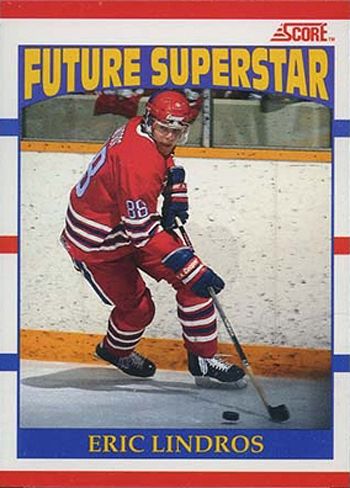
1990-91 Oshawa Generals Eric Lindros Jersey

Despite his steadfast and repeated warnings he would not play for them, the Quebec Nordiques drafted Eric Lindros with the first overall pick in the NHL Entry Draft on this day in 1991.

Pierre Page and Lindros 1991 Draft
The Nordiques Pierre Page with Lindros at the 1991 NHL Draft

Lindros, perhaps the most hyped and anticipated player since Wayne Gretzky or perhaps even Bobby Orr, had already led the Oshawa Generals of the OHL to the 1990 Memorial Cup championship with 45 points in 21 playoff games, scored 149 points in 57 games for the Generals to lead the league in scoring in 1991 and was named the league MVP and the CHL Player of the Year.

Lindros Oshawa Generals
Lindros with the Oshawa Generals

While Lindros was tearing up Canadian junior hockey, the Quebec Nordiques were the doormats of the NHL, having finished last overall in 1988-89 with 61 points, suffered through a dreadful 1989-90 season scoring a mere 31 points and "improved" to 46 points in 1990-91, earning the right to select first overall for the third consecutive year.

Having already refused to report to the Sault Ste. Marie Greyhounds in junior hockey, Lindros again made his wishes known that he had no intention of playing for the Nordiques due to several factors which did not meet his or his agent's satisfaction, including limited marketing potential, high tax rates in Quebec and the difficulties associated with the exclusively French speaking Quebec City.

With both sides at a standoff, the stubborn Nordiques selected him with the first overall pick anyway. The even more stubborn Lindros wasted no time in snubbing the Nordiques by refusing to wear the club's jersey for photos.

Lindros 1991 draft
Lindros refusing to wear a Nordiques jersey at the draft

Undaunted, the Nordiques president Marcel Aubut announced that they would build the team around Lindros and refused to trade him, claiming he would not have a career in the NHL as long as he held out. Meanwhile, Lindros played for Team Canada in the 1991 Canada Cup, briefly returned to the Generals for 13 games prior to joining the Canadian National Team for 24 games, participating in the 1992 World Junior Tournament and then the 1992 Winter Olympics, so there was no shortage of places for him to play during his unprecedented standoff with the Nordiques despite their 10-year, $50 million contract offer.

Eric Lindros 1992 Olympics
Lindros skating for Canada during his year long holdout

Eventually, after his year long holdout, the Nordiques relented and traded Lindros at the draft in 1992. The problem was, they agreed to trade him on June 20, 1992 to both the New York Rangers and the Philadelphia Flyers in separate deals!

Eventually the NHL arbitrator would rule in favor of the Flyers on June 30th and with that, it was the Flyers who sent a King's Ransom to the Nordiques in the form of Peter Forsberg, Mike Ricci, Ron Hextall, Steve Duchesne, Chris Simon, Kerry Huffman, two first-round draft choices (one of which was used to select Jocelyn Thibault while the other was traded away) plus $15 million!

The trade would send the franchise on the road to the Stanley Cup, which they would win in 1996 as the Colorado Avalanche, their first season after their relocation to Denver, Colorado.

Today's featured jersey is a CCM 1990-91 Oshawa Generals Eric Lindros jersey as worn the season in which Lindros scored 149 points in 57 games just prior to his being drafted first overall by the Quebec Nordiques.

1990-91 Oshawa Generals jersey

Bonus Jerseys: Today's first bonus jersey is a Tackla 1991-92 Canada National Team Eric Lindros jersey as used in the 1992 Olympics in Albertville, France while Lindros was refusing to play for the Nordiques in Quebec.

This jersey has all the graphics dye-sublimated onto the jersey and features the unusual white nameplate with red letters on a red jersey.

1991-92 Team Canada Lindros

Today's second bonus jersey is a CCM 1991-92 Quebec Nordiques team issued Eric Lindros jersey made for Lindros to wear in his planned rookie season of 1991-92 with the Nordiques, which went unworn as Lindros made good on his threats to not play for the Nordiques and instead embark on a schedule of games with primarily the Canadian National Team until the Nordiques traded him to the Philadelphia Flyers in time for the 1992-93 season.

1991-92 Quebec Nordiques Lindros jersey

Today's first video is the Nordiques following through on their promise to take Lindros first overall in the 1991 NHL Entry Draft.


Here is a report on Lindros refusing to play for the Nordiques prior to the draft.


Monday, June 21, 2010

1995-96 Quebec Nordiques Prototype Jersey

On this date in 1995, the NHL gave their approval for the sale of the Quebec Nordiques which resulted in their relocation to Denver, Colorado.

Originally founded in 1972 as one of the original 12 WHA franchises, the Nordiques played seven seasons in the WHA, winning the championship once in 1977.

1976-77 Quebec Nordiques

While the league folded following the 1978-79 season, four of the league's strongest and most stable franchises would enter the NHL as "expansion" franchises, which included the Nordiques.

Life in the NHL proved both exciting and difficult. The Nordiques rivalry with Quebec neighbors the Montreal Canadiens provided some of the most intense battles of the 1980's. After missing the playoffs in 1980, the Nordiques made the playoffs for seven consecutive seasons, including a division title in 1986 and a pair of trips to the conference finals in 1982 and 1985.

1985-86 Quebec Nordiques

Sadly for fans of the Nordiques, the club fell on some very hard times after 1987, missing the playoffs six out of the next seven seasons, including a horrid run from 1988-89 to 1991-92 when the club won a total of 75 games, an average of less than 19 per season, including last place finishes in 1988-89, 1989-90 (33 points behind the second worst team, more than the 31 they actually scored!) and 1990-91.

The Nordiques used the resulting draft picks to select players such as Mats Sundin and Adam Foote (1989), Owen Nolan (1990), Eric Lindros (1991), who they converted into Peter Forsberg, Ron Hextall, Chris Simon, Mike Ricci, Steve Duchesne, Jocelyn Thibault and $15 millon, Adam Deadmarsh (1993). This, in addition to the selection of Joe Sakic (15th overall in 1987), gave the Nordiques a very bright future on the ice, as evidenced by their record-setting turnaround from a 52 point season in 1991-92 to a 104 point season in 1992-93, an improvement of 52 points in one year!

Unfortunately, the future did not look the same off the ice. The weak Canadian dollar hampered the bottom line, as the team's revenues came in Canadian dollars but player salaries were paid in US dollars. No doubt the small size of Quebec City worked against the team and the exclusive use of French in the city both hurt it's ability to attract certain players, sponsorships and contracts with radio and TV outlets. It's home arena, the Colisee de Quebec, bulit in 1949 and it's smaller 15,750 capacity also limited the team's finances.

Nordiques president Marcel Aubut sought financial help from the Quebec provincial government as well as a new publicly funded arena, which was turned down. Eventually the club was sold to Comsat Entertainment Group, already owners of the Denver Nuggets of the NBA, who relocated the team to Denver, Colorado for the 1995-96 season - a year in which they proceeded to immediately win the Stanley Cup with a roster full of players selected to be Nordiques.

Nordiques art

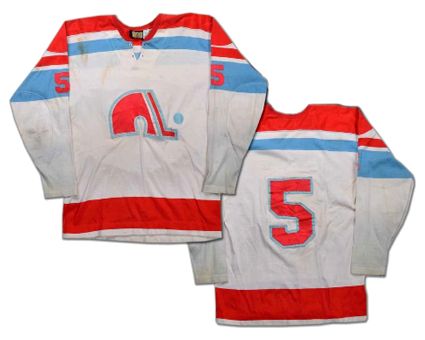
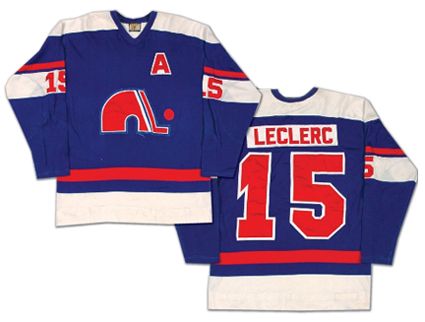
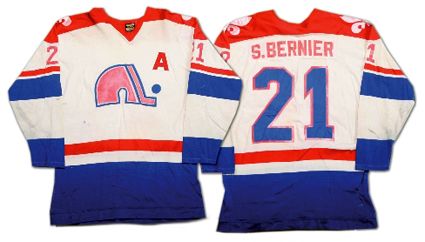
Today's featured jersey is a 1995-96 Quebec Nordiques prototype jersey. The original 1972 Nordiques jerseys used light blue had a considerable amount of red on both the shoulders and waist stripe. The following season the blue was changed to a considerably darker shade and the amount of red was limited to the shoulders on the home jerseys and narrower striping.

The familiar Nordiques style was adopted in 1975 and remained in use through the Nordiques final season in Quebec twenty years later, although a new jersey with a modernized logo was unveiled on March 30, 1995 which was originally intended to be worn by the Nordiques in 1995-96, only it's been reported that the club missed the deadline for approval of the jersey in time for the start of the season and the jersey was now scheduled to become the team's new jerseys for the 1996-97 season, only to see the club relocate to Denver, Colorado, where they would be renamed the Avalanche, leaving the now orphaned jerseys to go forever unworn.

The only known photo of the original jerseys shows (not very thrilled) team executives (or perhaps journalists) modeling the sweaters, failing to show even the full length of the jerseys to reveal the intended waist striping.

Nordiques unused 1995-96 jerseys

None of these jerseys were ever mass produced for retail sale, although some attempts to create them have been made, but none in any great quantities and some less accurate than others.

We've tried to research these jerseys as best we can, but if you have any more details, corrections or additions to our research, feel free to let us know at

Our video section today begins with the 1984 playoffs "Good Friday Brawl"
between the Nordiques and Canadiens.


Here is a report on Eric Lindros refusal to play for the Nordiques, a stance
which would eventually lead to the long-term success of the franchise - after it moved to Denver.


Finally, two more videos showing how the team was playing well, but
financially the club was a state of financial decline.


Sunday, June 20, 2010

1995-96 Tampa Bay Lightning Roman Hamrlik Jersey

The 1992 NHL Entry Draft was held on this date in Montreal and the Tampa Bay Lightning selected defenseman Roman Hamrlik of Czechoslovakia with the first overall pick, the first Czech ever drafted #1 overall.

Hamrlik and Esposito
Hamrlik with Phil Esposito after being drafted #1 overall in 1992. So why is the #1 pick given a jersey with the #2?

The Ottawa Senators followed with center Alexi Yashin at #2, Mike Rathje went third to the San Jose Sharks, left wing Todd Warriner fourth to the Quebec Nordiques and the New York Islanders rounded out the top five with the rugged Darius Kasparitis, making three defensemen among the top five.

Other notable selections in the first round were Cory Stillman at #6 to the Calgary Flames, Sergei Gonchar went 14th to the Washington Capitals and long-time NHLers Martin Straka 19th to the Pittsburgh Penguins and Grant Marshall 23rd to the Toronto Maple Leafs.

Later round successes were Michael Peca at #40 to Vancouver, Darren McCarty #46 to Detroit, #65 Kirk Maltby to Edmonton, #88 Jere Lehtinen to the Minnesota North Stars, Adrian Aucoin #117 to Vancouver, the indestructable Ian Laperriere to St. Louis at #158, Stephane Yelle at #186 in round 8 to New Jersey and future NHL All-Stars Nikolai Khabibulin #204 in Round 9 to Winnipeg and in Round 10, Anson Carter, #220, to Quebec.

The latest pick to see NHL action was Andrei Vasilyev (#248) who played 16 games over four seasons with the Islanders (15) and the Phoenix Coyotes (1).

Hiroyuki Miura became the first Japanese player drafted at #260 in the 11th and final round, if you don't count the fictitious Taro Tsujimoto taken in 1974 by Punch Imlach of the Buffalo Sabres! Miura played six games with the Wheeling Thunderbirds of the ECHL in 1993-94, but never came close to playing in the NHL.

Hamrlik made his NHL debut later in 1992 with the Lightning and played in 67 games and scored 21 points. He maintained his scoring pace the next season, but raised his toughness level, nearly doubling his penalty minutes from 71 to 135. Three more seasons in Tampa followed, including a career high 16 goals and 65 points in 1995-96, until Hamrlik was traded to the Edmonton Oilers halfway through the 1997-98 season as part of a five player trade.

Two and a half seasons in Edmonton were followed by a trade to the New York Islanders, where he played for four full seasons. He spent the lockout season of 2004-05 like many other European NHLers by returning to the final club he played for prior to moving to North America, in Hamrlik's case, ZPS in Ziln of the Czech Republic.

With the lockout concluded, Hamrlik signed with the Calgary Flames as a free agent for two seasons prior to choosing the Montreal Canadiens as his next home beginning in 2007-08.

A major reason for Hamrlik's lengthy NHL career has been his remarkable consistency. Since 1994, Hamrlik has scored between 21 and 46 points, save for the one season he hit 65. He has also missed a minimum of games, with 13 of the last 14 seasons playing 70 games or more.

Internationally, his opportunities have been somewhat limited by his regular appearances in the NHL playoffs, but Hamrlik as competed for the Czech Republic in the 1994 World Championships, the 1996 World Cup, the 1998 Olympics where he won a gold medal, the 2002 Olympics, the 2004 World Championship and the 2004 World Cup.

Thanks to his longevity he has currently surpassed 1200 games played and is approaching 600 points and 150 goals, currently sitting at 590 points at 148 goals.

Today's featured jersey is a CCM 1995-96 Tampa Bay Lightning Roman Hamrlik jersey as worn during his highest scoring season when he scored a career high 16 goals and 65 points. He also made his first appearance in the NHL playoffs that season.

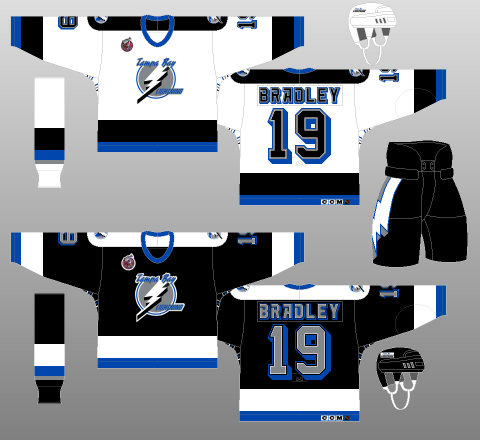
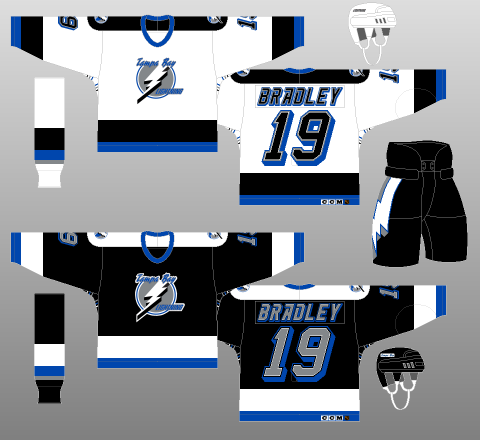
This style Lightning jersey was originally worn in their debut season of 1992-93 with a silver numbers and a blue drop shadow and a unique font for the names on the back. The following season the fonts were italicized, making for the best looking Lightning jerseys in their history.

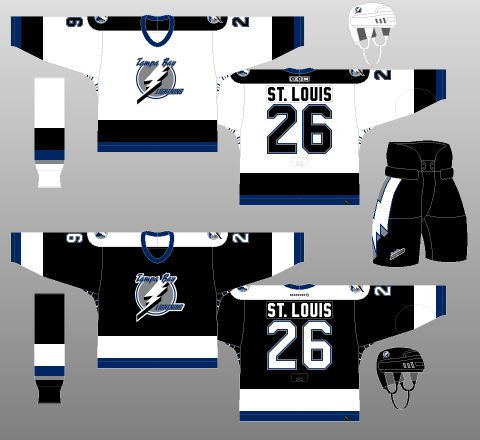
For some reason, the club changed to radially arched letters and the now white paintbrush font numbers, which have little to do with the name "Lighting", after only just one season. This style remained in use through the 1999-2000 until they changed to a much more boring block style font and one color names with no arching or any other feature to make them unique, as all other Lightning fonts had been throughout their history up until this point. It's a change we've never understood, considering their past history of unusual choices.

Tampa Bay Lightning jersey

Today's video section begins with Roman Hamrlik being selected first by a Third String Goalie favorite, Phil Esposito.


Next, Hamrlik converts the world's best saucer pass by Tomas Plekanec after Plekanec skates the length of the ice through the entire Islanders team to win the game in overtime.


Finally, highlights of Hamrlik's time with both Calgary and Montreal, set to the typical YouTube soundtrack. No penalty points for turning your speakers off.


hit counter for blogger