Saturday, August 1, 2009
2006 Switzerland National Team David Aebischer Jersey
Today is Swiss National Day, first celebrated in Bern in 1891 on the 600th anniversary of the Federal Charter of 1291, also known as the Letter of Alliance, which documented the union of three "cantons" in what is now central Switzerland, Uri, Schwyz and Unterwalden. The three regions allied for defense purposes and eventually grew into modern Switzerland.
Following a public vote in 1993, it was made an official holiday in 1994 and is celebrated each year with paper lantern parades, bonfires, hanging strings of Swiss flags and fireworks.
The Swiss National Ice Hockey Team is a founding member of the International Ice Hockey Federation (IIHF) which is headquartered in Zürich, Switzerland. While not considered one of the elite hockey nations when it comes to gold medals and championships, the Swiss are a knocking on the door of being in the top echelon and are currently ranked 7th in the 2009 IIHF rankings, ahead of Belarus, Slovakia, Latvia, Norway and Germany.
Despite not having won a medal in the World Championships since 1953, they are not a team one dares to overlook, as they defeated the Czech Republic 3-2 and shutout traditional hockey power Canada 2-0 two days later during the 2006 Olympics in Turin, making it as far as the quarterfinals.
The goaltender for Switzerland during their 3-2 win over the Czechs was former Colorado Avalanche netminder David Aebischer, perhaps the best known player from Switzerland, along with goalie Martin Gerber, Jonas Hiller and defenseman and Swiss National Team captain Mark Streit.
Aebischer was chosen 161st overall by Colorado in the 1997 NHL Entry Draft while playing for HC Fribourg-Gottéron in the Swiss National League A. He played a couple of seasons for the Hershey Bears of the AHL before moving up to join the Avalanche in 2000-01 where he would have his name engraved on the Stanley Cup as a backup to Patrick Roy. He would become the Avs #1 goalie for the 2003-04 season, following the retirement of Roy after the 2003 playoffs, and have a fine season, finishing with a 32-19-9 record and a goals against average of 2.09.
Following the lockout season of 2004-05, when Aebischer played for HC Lugano of Switzerland, he would return to the Avalanche for the 2005-06 season, only to be traded to the Montreal Canadiens at the trading deadline. He would play one full season in Montreal before signing a free agent contract with the Phoenix Coyotes, only to lose out in the crowded goaltending battle and find himself briefly in the AHL before returning to HC Lugano on loan, where he has now played two seasons.
In Switzerland, SC Bern traditionally leads all of Europe in attendance figures, last season averaging 16,172 fans per game, with no other club over 13,800 and only five over 10,000. The next highest Swiss club is Champions League winners ZSC Lions at #12 with 7,720. SC Bern has lead all of Europe in attendance for eight consecutive seasons. The Swiss National League A as a whole ranks second in Europe with an average of 6,073, second only to Sweden's Elitserien's 6,260 and ahead of the top leagues in Germany, Russia, Finland, the Czech Republic and Slovakia.
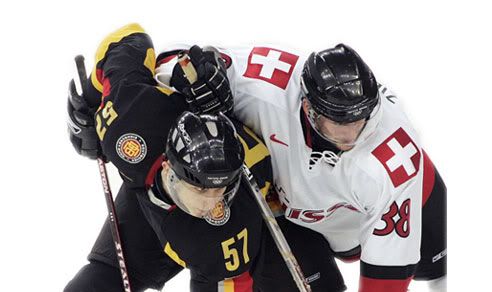
Today's featured jersey is a 2006 Switzerland National Team David Aebischer jersey as worn in the 2006 World Championships in Riga, Latvia. This jersey was originally purchased with "Swiss" wordmark logos on the shoulders as worn in 2005, but I instructed my customizers to create the Swiss flag patches out of twill (seen here more clearly on a white jersey). I also added some of my custom made "Tissot" sponsorship patches to give it the look of a World Championships jersey. The IIHF new logo patch on the rear hem completes the look of one of my favorite jerseys in my collection.
Some of my other favorite elements of this jersey are it's red, white and black color combination, the retro feeling lace-up neck collar and the distinctive number font used by only Switzerland and Finland during this time period.
Today's video selections begin with highlights of Switzerland's victories over the Czech Republic and Canada from the 2006 Olympics in Torino, Italy.
Next up is a highlight video Switzerland from the 2008 World Championships, including their 4-2 win over Sweden. Be sure to notice their throwback jerseys from the first game versus France.
Here is an impressive display by the Swiss fans prior to a game in where else but Bern, prior to a game vs. Germany in the 2009 World Championships hosted by Switzerland chanting "Hopp Schwiiz! Hopp Schwiiz!", the traditional Swiss fans cheer of support.
Here is a highlight video of some spectacular saves by David Aebischer while playing for not only Colorado, but also HC Lugano and Switzerland.
While we generally go out of our way to avoid posting fight videos given another choice, there's always something about a goalie fight that amuses us, and when you combine that with the fact this is from Aebischer's time with the Hershey Bears, we just couldn't pass this one up.
Labels:
Aebischer David,
IIHF,
Switzerland
Friday, July 31, 2009
1991-92 Chicago Blackhawks TBTC Dominik Hasek Jersey
July by the Numbers concludes with jersey #31, an Original Six Turn Back the Clock jersey.
Dominik Hasek became the youngest player in in professional hockey history when, at age 16 he suited up for HC Pardubice in the Czechoslovak Extraliga in 1980. He would play for Pardubice for nine seasons, including winning the championship twice in both 1987 and 1989 and be named the top player of the Czechoslovak Extraliga in 1987, 1989 and 1990 as well as the Goaltender of the Year for five consecutive seasons from 1986 through 1990.
He would play one season for Dukla Jihlava in 1989-90 before moving to North America as the restrictions on players from communist countries were now lifted after what would have been a highly successful, complete ten year career for many, but due to his record setting early start as a teenager, Hasek was still only 26 years of age.
Drafted 199th overall in the 10th round back in the 1983 NHL Entry Draft by the Chicago Blackhawks, when players from communist countries had little chance of ever playing in the NHL, Hasek would not even find out he had been drafted until several months later! He would begin his time in North American hockey in the same place Wayne Gretzky started his professional career, Indianapolis, Indiana, playing for the Indianapolis Ice of the IHL in 1990-91. He would make his NHL debut that same season, a 1-1 tie vs. Hartford on November 6th. He would see action in five games for the Blackhawks - eight years after being originally drafted. His first win would come on March 8, 1991, a 5-3 win over his future club the Buffalo Sabres.
The following season, backing up Chicago's then number one goaltender Ed Belfour, Hasek would split his time between Chicago and Indianapolis, playing in 20 games for each club. He would post a 10-4-1 record with a 2.60 goals against average that season for Chicago and would earn his first of 81 career shutouts with a 2-0 blanking of the Toronto Maple Leafs on January 9th, 1992. The Blackhawks would make it all the way to the Stanley Cup Finals that year before losing to the Mario Lemieux led Pittsburgh Penguins. Unable to win the starting job from Belfour, Hasek would be traded during the offseason to the Buffalo Sabres where he would begin the next phase of his career.
The jersey I am featuring today is a 1991-92 Chicago Blackhawks Turn Back the Clock Dominik Hasek jersey worn by Chicago during the NHL's 75th anniversary season when Hasek wore #31, after initially wearing #34 during his first season with the Blackhawks.
As part of the celebrations of the NHL's 75th anniversary in the 1991-92 season, the Original Six teams, Boston, Chicago, Detroit, New York, Montreal and Toronto, all wore a Turn Back the Clock jersey from their past at various times throughout the season. The Blackhawks "barberpole" jersey was originally worn in the 1937 season and did not feature any sleeve numbers.
This jersey does feature the NHL 75th anniversary patch, as worn by all players during the 1991-92 season.
Here is a collection of many great saves made by Hasek in the 1992 Cup Finals versus Pittsburgh while playing for the Blackhawks.
Thursday, July 30, 2009
2002 Team Canada Alternate Martin Brodeur Jersey
July by the Numbers treks up to the Great White North for jersey #30 today.
Nike first started making international jerseys in 1996 for the first World Cup of Hockey when they supplied five of the eight teams, the United States, Russia, Finland, Germany and Slovakia. These attractive jerseys had bold graphics on the bottom of the jersey in a "waving flag" style and pronounced Nike swoosh logos on the shoulders, one visible from the front and the other from the back, in the boldest manufacturer logo placement since the Reebok shoulder logos of the 1994 Olympics.
Nike then outfitted the entire field at the 1998 Nagano Olympics and the yoke collar made it's first appearance. The use of the template also arrived, as Canada and the Czech Republic wore identical jerseys with arched striping on the chest done in their respective colors, while Kazakhstan, Germany and Finland all wore similar looks to each other.
For 2002 Nike was again the sole supplier in Salt Lake City, as the United States joined the Czech Republic and the others in adopting the same templated look as the majority of the teams kept the same look that they wore in 2002.
But there was one development not seen before, as Canada introduced the alternate jersey to the international hockey scene. The jerseys featured the retro Canadian Maple Leaf logo orginally used by Canada's national team at the first Winter Olympics in Chamonix, France in 1924 when Canada captured the gold medal.
The jersey we am featuring today is a 2002 Team Canada alternate Martin Brodeur jersey. It features the International Ice Hockey Federation (IIHF) patch on the back.
This jersey was worn in Canada's opening game of the Salt Lake City Olympics on February 15th, 2002 versus Sweden, a disappointing 5-2 loss for the Canadians. It was quickly deemed that the attractive throwback alternates were now "bad luck" and they were sadly never worn again.
Brodeur did not play in the game versus Sweden, as Curtis Joseph was the starter that night. On the heels of the loss, Brodeur got the start in game two of the Qualifying Round, defeating Germany 3-2. Following a tie with the Czechs, Brodeur and Canada defeated Finland in the Quarter Finals 2-1 before drawing Belarus, fresh off their shocking upset of Sweden. Canada would easily defeat Belarus 7-1 and advance to take on the Americans on their home ice where they had twice before taken gold, in 1960 and again in 1980.
An inspired Canada defeat the USA 5-2 to capture the Olympic gold for the first time since 1952. Brodeur would finish the tournament with a 4-0-1 record and a goals against average of 1.80.
Labels:
Brodeur Martin,
Canada
Wednesday, July 29, 2009
2001-02 Wilkes-Barre/Scranton Penguins Tom Kostopoulos Jersey
July by the Numbers returns to the AHL for jersey #29.
The Wilkes-Barre/Scranton Penguins franchise history can be traced back to 1981 when the Fredericton Express came into being in New Brunswick, Canada as a minor league affiliate to the Quebec Nordiques. The club relocated to Halifax, Nova Scotia and was known as the Citadels from 1988 to 1993 when they once more were moved, this time to Cornwall, Ontario where they played until 1996.
At that point the franchise was left dormant for three years while property of the Colorado Avalanche, who sold the club to the Pittsburgh Penguins, who placed the club in Wilkes-Barre/Scranton, Pennsylvania as their primary affiliate, and because of that relationship, they are affectionately knows as "The Baby Pens".
Consistently competitive, they have made the playoffs in eight out of ten seasons, advancing to the Calder Cup Finals three times as Eastern Conference Champions, but have yet to capture the title.
Notable players who have suited up for The Baby Pens are Colby Armstrong, Ty Conklin, Marc-Andre Fleury, Tyler Kennedy, Kris Letang, Ryan Malone, Michel Ouellet, Toby Petersen, Maxime Talbot, Ryan Whitney and Tom Kostopoulos.
Kostopoulos, a one time WBS Penguins captain, holds career franchise records for goals with 97, assists at 149 and, not surprisingly, points, totaling 246 as well as games played with 318 and was drafted by the Pittsburgh Penguins 204th overall in the seventh round of the 1999 NHL Entry Draft.
After playing for the WBS Pens for four seasons he played 60 games for Pittsburgh in 2003-04, scoring 22 points. He would sign a free agent contract with Los Angeles the following season, which he once again spent in the AHL, this time playing for the Manchester Monarchs. In 2005-06 Kostopoulos would finally spend an entire season in the NHL with the Kings where he would equal his 22 point career high. The next year in Los Angeles would see him again register 22 points.
2007 would see him move to the Montreal Canadiens as a free agent and in 2008-09 he would equal his highest point total yet again, scoring the now familiar 22 points for the fourth time in five NHL seasons. Next year will see him suit up for the Carolina Hurricanes where they can most likely count on... 22 points!
Today's featured jersey is an SP brand 2001-02 Wilkes-Barre/Scranton Tom Kostopoulos jersey.
This jersey features a custom made Blue Cross sponsorship patch on the right shoulder as well as another custom made stylized American flag patch, which was worn on the right chest following the terrorist attacks on September 11th, 2001.
This highly attractive jersey features my personal favorite combination of italicized and drop shadowed numbers, with the base color done in the textured Glacier Twill, a herringbone pattern woven into the fabric.
The WBS Pens were fond of tweaking their number styles each season with this style jersey, as they used a variety of red drop shadows, yellow drop shadows, back to red drop shadows followed by a simple red outline in their first four seasons.
This is without a doubt one of my favorite jerseys in my collection, as I really like the color combination used, the bold, angular striping with equal width bands of color, the pointed shoulder areas and the italicized and drop-shadowed numbers. Add the unique, and lengthy, choice for the name on the back and addition of the custom made patches it makes for a really a striking jersey I felt came together very nicely, especially when I was able to contact the WBS Pens directly and to learn which company did the lettering for the club during the time period when they wore this style jersey and was able to have mine customized by the very same outfit to the exact specifications used by the team in the season I wanted to replicate.
Here's Tom joining the ranks of notable hockey player/actors with an appearance on MADtv along with Steve Avery and Scott Thornton.
Here is a video released by the WBS Penguins for their annual St. Patrick's Day game in 2004 documenting all the previous jerseys worn for the occasion. For some reason the song lasts much longer than the video highlights do, so enjoy the first 1:50 of the video and then tap your toes to the music for the next couple of minutes. Such are the wonders of YouTube I suppose...
Labels:
AHL,
Kostopoulos,
Wilkes-Barre/Scranton Penguins
Tuesday, July 28, 2009
1987-88 Dynamo Riga Igor Pavlov Jersey
July by the Numbers begins to wind down with jersey #28 from Latvia.
Dynamo Riga (or Dinamo Riga) was founded in 1946 and one of eleven teams which played in the first Soviet championship tournament. Their best ever finish was during the 1987-88 season when then finished as runner-up to the always dominant Central Red Army Club (CSKA) in the championship final.
Viktor Hatulev of Dynamo Riga became the first player drafted by an NHL club when the Philadelphia Flyers took a flyer on Hatulev with the 160th overall pick in 1975. He was also selected 116th overall by the Cleveland Crusaders in the WHA draft in the same year, as the WHA teams had a reputation of using the NHL draft results as their own scouting reports! He never made it to the NHL due to the political climate of the time not allowing Soviet players to leave for North America.
Helmut Balderis had the most goals and points in the 1976-77 Soviet League season while playing for Dynamo Riga en route to capturing the league's Most Valuable Player Award. He would also lead the Soviet league in goals in 1975-76 and points in 1982-83.
After the breakup of the Soviet Union, Dynamo Riga would play until 1995 as a member of the International Hockey League, which would later evolve into the Russian Super League, when after nearly 50 years the club would disband.
The franchise's most recognizable player in North America was easily Arturs Irbe, best known as a goaltender for the San Jose Sharks and Carolina Hurricanes.
In early 2008 the club was reformed and is now competing as a member of the Kontinental Hockey League (KHL).
Dynamo Riga traveled to North America in 1989 and took part in the Super Series, a series of exhibition games versus various NHL clubs, posting a 2-4-1 record. It was during this series of games that I was able to obtain today's featured jersey, a 1989-90 Dynamo Riga Igor Pavlov jersey.
This jersey is typical of the European jerseys of the time period in that it has all dye-sublimated graphics like the crests and numbers, but the name on the back is quite unusual in that it is a crudely printed name using stencils for the Cyrillic letters onto a piece of fabric which was then somewhat carelessly sewn onto the jersey.
Pavlov's playing career would take him from Russia, where he would play in Riga for seven seasons before moving to the Czech league for one season before spending the final seven seasons of his career in Germany, the majority of which were with Landsberg EV before moving into coaching.
Here's an amazing find, footage of Dynamo Riga and Arturs Irbe vs. the Calgary Flames from the 1988 Super Series.
Labels:
Dynamo Riga,
Pavlov
Monday, July 27, 2009
2004 Russia National Team Alexei Kovalev Jersey
July by the Numbers begins to wind down with jersey #27 from Russia.
Alexei Kovalev was drafted by the New York Rangers 15th overall in the 1991, the first Russian drafted in the first round of the NHL Entry Draft.
His first NHL season was the 1992-93 season, when he split time between the New York Rangers and it's top minor league affiliate of the time, the Binghamton Rangers of the AHL.
Now with the Rangers full time, he would play 76 games and score 23 goals and 33 assists for 56 points in the 1993-94 regular season, plus adding another 9 goals and 12 assists for 21 points during the playoffs as the Rangers would capture the championship, making Kovalev, along with teammates Alexander Karpovtsev, Sergei Nemchinov and Sergei Zubov the first Russians to have their names engraved on the Stanley Cup.
He would play four more seasons in New York, but 14 games in the 1998-99 season Kovalev would be traded to the Pittsburgh Penguins, where he would blossom offensively, scoring his only 40 goal season of his career with 44 and add 51 assists for his best season of his career with 95 points in 2000-01.
During his fifth season in Pittsburgh, Kovalev would find himself being traded back to the Rangers in what has been described as a cost-cutting move by the Penguins. Late in the following season he would be again traded, this time to the Montreal Canadiens, where he would register just a single goal and a pair of assists in 12 games for Montreal but he would come alive in the playoffs, with 10 points in 11 games.
After spending the lockout season of 2004-05 with Ak Bars Kazan in the Russian Super League, along with eight other NHLers in an unsuccessful attempt to bring the championship to Kazan during it's 1000th Anniversary, he would return to Montreal for the next four seasons, with the highlight being his 35 goal, 49 assist, 84 point season, the second highest offensive output of his career.
He currently sits at 394 goals and 941 points in his NHL career and will be looking for 400 goals and 1000 points in Ottawa, where he will being playing next season on a two year contract.
Kovalev was named as captain of the Eastern Conference All-Star Team in Montreal in 2009, the first Russian to captain an All-Star Team. He would live up to the honor by scoring two goals and an assist during the contest, as well as the game-winning shootout goal to capture the Most Valuable Player award of the game.
In addition to his NHL accomplishments, he has played for his country on numerous occasions. He represented the Soviet Union in the 1990 and 1991 European Junior Championships and the 1992 World Juniors where he won a gold medal.
Kovalev took home another gold at the 1992 Olympics playing for the Unified Team, as the breakup of the Soviet Union was still being sorted out at the time.
With the political situation now sorted out, Kovalev has now represented Russia seven times, including three World Championships, including 2005 when he was named Best Forward, twice at the World Cup of Hockey and twice at the Olympics in 2002 and 2006.
The jersey I am featuring today is a 2004 Russia National Team Alexei Kovalev jersey as worn in the second World Cup where Kovalev scored twice and added one assist in four games as Russia beat the United States 3-1, with Kovalev scoring the game winning goal and was named First Star of the contest, lost to Canada 3-1 and defeated Slovakia 5-2 to finish second in the North American Pool before being eliminated in a rematch 5-3 by the United States in the quarterfinals.
This jersey features additional details, such as the 2004 World Cup of Hockey tournament patch worn on the chest, the International Ice Hockey Federation logo patch worn on the lower back of each players jersey during the tournament as well as the assistant captain's "A" worn by Kovalev during the competition.
Here is a glimpse at the sublime skills of Kovalev.
And somehow they managed to not include this beauty...
Finally, an interview with a very young and very excited Kovalev after capturing the Stanley Cup in 1994 with the Rangers. The volume of the video is quite low, so you will have to turn up your volume a lot, but be sure to turn it back down again afterwards!
Labels:
2004 World Cup of Hockey,
IIHF,
Kovalev Alexei,
Russia
Sunday, July 26, 2009
2005-06 University of Minnesota Golden Gophers Phil Kessel Jersey
July by the Numbers enters the home stretch as we reach jersey #26.
Born in Madison, Wisconsin, Phil Kessel was a member of the U. S. National Under-18 Team based in Ann Arbor, Michigan and surprisingly chose to play his college hockey at the University of Minnesota over his hometown Wisconsin Badgers - a choice that did not go down well with the Badger faithful upon his return to Madison.
The Under-18 team, along with the Under-17 team, comprises the National Team Development Program (NTDP) operated by USA Hockey. Both teams are made up of players who have survived tryouts and have been judged the most talented in the nation in their age groups. Both teams compete in the top junior hockey league in the United States, the United States Hockey League (USHL), with the U-18 team also playing a longer schedule with the addition of select games versus various NCAA college teams as well as the International Ice Hockey Federation Under-18 World Championships, which the USA has won in four of the 11 years the championship has been contested.
Notable players who have gone through the NTDP include NHLers Rick DiPietro, Patrick Kane, Erik Johnson, Keith Ballard, John-Michael Liles, Jack Johnson, Mike Komisarek, Matt Carle, Patrick Eaves, Ryan Suter and the aforementioned Phil Kessel.
Kessel would also compete in the World Juniors (for players under 20 years of age) as an 18 year old in 2005 and again as a 19 year old in 2006 where he was the tournament's leading scorer overall, with 11 points in seven games, a tournament that included future Pittsburgh Penguin star Evgeni Malkin and future Washington Capital Nicklas Backstrom.
He would finish his career with the NTDP with the record for Most Career Goals (104), most points (180) and the single season record for goals (52).
In the 2005-06 season Kessel would finish second in scoring for the Gophers with 18 goals and 33 assists for 51 points as a freshman, second only on the club to First Team All-American Ryan Potulny.
After just one season in college, Kessel would turn pro and enter the NHL with the Boston Bruins. He would be diagnosed with cancer and undergo surgery on December 12th of his rookie season, amazingly returning to the lineup after missing only 12 games. In 70 games that year, Phil would score 11 goals and 18 assists for 29 points. During the campaign, he would tie the record held by Ed Olczyk for the longest point streak by a rookie at 18 games. Following the season, Kessel would be named as the recipient of the Bill Masterton Memorial Trophy for his perseverance, sportsmanship and dedication to hockey, the first rookie to ever win the award.
After the completion of the 2006-07 season Kessel would once more put on a Team USA sweater in the World Championships in Moscow, Russia and again in 2008 in Quebec City in Canada.
The jersey I am featuring today is am Easton 2005-06 University of Minnesota Phil Kessel home jersey, the only season this style of jersey was worn.
To be honest, it's not my favorite Gophers style due to the size and shape of the maroon shoulder areas, but it did look better on the ice than it does laying flat. Still, I was not disappointed when they changed again to a much more attractive style the following season.
One aspect if this style that I do like is the name on the back being located inside the enlarged shoulder area in a different color than the numbers.
Here's a classic highlight of Phil giving it back to the Wisconsin fans on his return to Madison after being booed all game long.
This video features Kessel talking about his love of hockey.
Here are a pair of videos about Phil and dealing with cancer.
Labels:
Kessel Phil,
University of Minnesota,
WCHA
Saturday, July 25, 2009
1994-95 Minnesota Moose Stephane Morin Jersey
July by the Numbers reaches #25 as we head north to Minnesota.
While the Minnesota Moose only played two seasons in St. Paul, Minnesota after the departure of the NHL's North Stars for Dallas, they provided some exciting hockey, generally of the rougher kind typical of the International Hockey League in those days, and one wildly successful logo, which was ranked #1 in a poll by The Hockey News and led all minor league teams in terms of merchandise sales.
One of the highlights for the Moose during their first season in the old St. Paul Civic Center was undoubtedly the play of Stephane Morin, who scored 33 goals and a 81 assists, nearly double the next closest on the roster, for 114 points to win the league scoring title to capture the Leo Lamoureux Memorial Trophy.
Other players to suit up for the Moose in Minnesota were Dave Christian, who set the team record for goals in a season with 38 and whose Moose road jersey was featured earlier here at Third String Goalie, team captain and current University of North Dakota head coach Dave Hakstol, all-time team penalty minute leader Brad Miller, former Red Wing and 16 year NHL veteran Reed Larson, the first North American to play in Russia Tod Harjte, whose memoir of his experience "From Behind the Red Line" can be purchased here (six used copies for a PENNY at the time of this writing!), former NHLers goaltender Tom Draper, Stew Gavin, Gordie Roberts and last but not least, the unfortunately named goaltender Parris Duffus.
Today's featured jersey is a Starter 1994-95 Minnesota Moose Stephane Morin home jersey which features the IHL 50th Anniversary patch worn during the Moose's first season when Morin won the IHL scoring title.
While the three color combination of purple, forest green and black was a questionable choice at best on the black road jerseys, it does come across slightly better on the home white jerseys, but not by much. While the separation of the green from the purple and black is marginal for the larger numbers, it really becomes a dark mass when reduced in size for the name on the back.
While the back of the jersey has it's flaws, the front of the jersey is a winner, with the popular Moose logo and the added shot of color from the IHL anniversary patch.
Here's some rare non-fighting clips of the Moose in action.
It's back to business as usual with the fisticuffs, but another rarity, the Moose in action at the St. Paul Civic center after the famous clear boards had finally been replaced due to age and the advent of dasherboard advertising rendering them ineffective.
For comparison, here's a WHA Fighting Saints highlight package with some road games with the usual boards and some home game action with the unmistakable clear boards.
Labels:
IHL,
Minnesota Moose,
Morin Stephane
Friday, July 24, 2009
2001-02 Houston Aeros Alternate Stephane Veilleux Jersey
July by the Numbers heads down to the Lone Star State for stop #24 today.
The Houston Aeros of the old World Hockey Association began play in 1972 and would go on to win four regular season titles, four Division championships and a pair of Avco World Trophies as champions of the WHA behind the Howe family, legendary Gordie and sons Mark and Marty. The Aeros final season would be 1977-78.
Fast-forward to 1994 when the International Hockey League would expand and the new Houston franchise would adopt the Aeros name in honor of the original WHA club, the second such team named after a WHA team, following the Phoenix Roadrunners.
The Aeros would play seven seasons in the IHL, winning the championship and the Turner Cup in 1999. When the IHL folded in 2001 the Aeros were one of six teams to join the American Hockey League, where they would win an AHL championship, claiming the Calder Cup in 2003, joining the Chicago Wolves as the only two teams to win both the Turner Cup and the Calder Cup.
Today's featured jersey is a 2001-02 Houston Aeros alternate Stephane Veilleux jersey. This jerseys primary logo is the "A" taken from the Aeros wordmark. The team's primary logo, it's ever-popular bomber logo, is used as the secondary logo on the shoulders in this case.
This style jersey was worn for only one season, as the Aeros would traditionally introduce a new alternate each season. The back numbers are the first example of kiss-cut lettering I became aware of. Instead of smaller white numbers being sewn on top of a larger blue layer to create two color numbers, a narrow blue outline layer (which is open in the center to allow the base color to show through) is sewn on top of a full size white layer to create the two color number effect.
My jersey also features the custom made "Whataburger" sponsorship patch created with my transfer process to give it an extra look of authenticity.
Veilleux played four seasons for the Aeros, including leading the team in playoff scoring during their 2003 Calder Cup championship run, and parts of six seasons for the Minnesota Wild, with a high of 18 points in both of the previous two seasons. He recently signed a free agent contract with the Tampa Bay Lightning, ending his time in Minnesota. He once totaled 115 points in a season for the Val-d'Or Foreurs of the QMJHL.
Labels:
Houston Aeros,
IHL,
Veilleux Stephane
Subscribe to:
Posts (Atom)